
Nueces County constables deny further collaboration with ICE, request back pay
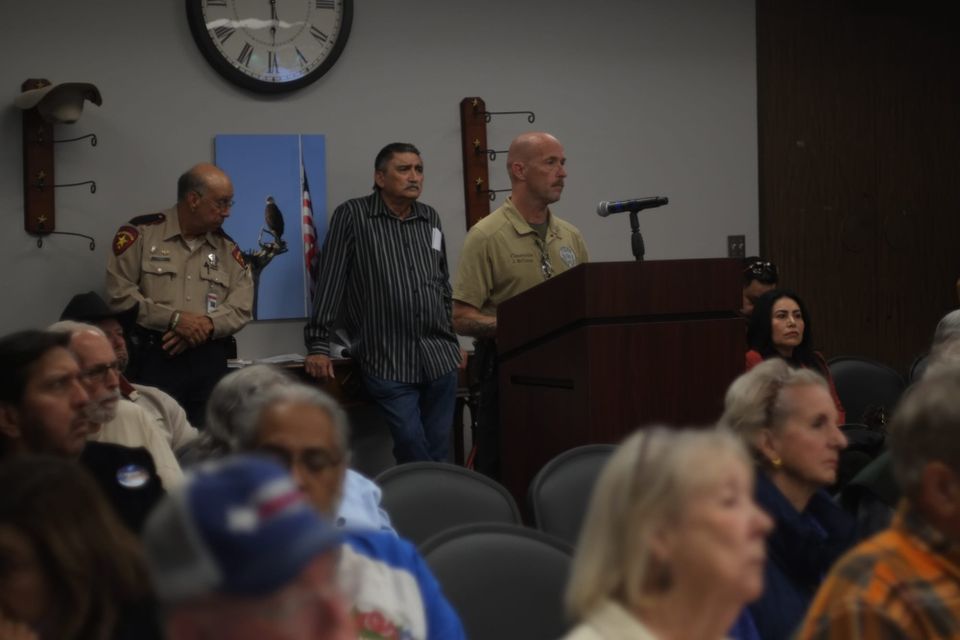
The Nueces County Commissioners Court was standing room only on Nov. 18 after word spread about several controversial agenda items, one of which was related to immigration enforcement by county constables.
The consent agenda item, ultimately pulled for discussion, was the ratification and acceptance of a series of agreements between U.S. Immigration and Customs Enforcement (ICE) and Nueces County constables to “(facilitate) the County's receipt of reimbursement for services previously performed and funds currently owed,” the meeting agenda said.
A county policy limiting the public comment portion of the meeting to 30 minutes prevented at least 12 speakers from commenting on the item. You can watch the public comment portion of the meeting here.

After a short public discussion that led to a lengthy executive session, a motion was made to separate the reimbursement request from the acceptance and ratification of the five Memorandas of Agreement (MOAs) signed by constables between Jan. 2 and June 16 to assist ICE via its 287(g) Task Force Model.
Precinct 2 Commissioner Joe A. Gonzalez made a motion following executive session to “move to direct constables to seek any available reimbursement from ICE for previously signed 287(g) agreement(s) authoriz(ing) … (the) county judge … to sign any reimbursement documents necessary, only for reimbursement.” The motion passed unanimously.
It’s unclear whether the 287(g) agreements will ultimately be terminated but Precinct 2 constable Jason McCahan told Chisme after executive session that constables don’t plan on resuming participation since halting 287(g) tasks in May, when they learned the MOAs should not have been signed without approval from the commissioners court.
“The individual elected officials, from what I understand, potentially have the authority to do an MO(A),” Nueces County Judge Connie Scott said during the meeting. “The reason this one becomes illegal without coming to court for ratification is because of the financial burden included.”
Nueces County constables serve as elected licensed peace officers. Constable deputies can perform various law enforcement functions, like issuing traffic citations. They also serve warrants and civil papers, such as subpoenas and restraining orders.
McCahan said constable deputies in more rural areas, like precinct 5 in Robstown, perform law enforcement functions more often than precincts like his, which is in Flour Bluff. Constables in more populated areas spend most of their time serving papers, he added.
Although all five Nueces County constables signed MOAs earlier this year, only precincts 2, 3, 4, and 5 underwent the necessary training to assist ICE via its 287(g) program and therefore are eligible to request reimbursement from ICE.
Precinct 1 is not eligible for reimbursement despite signing an MOA in June because no deputies underwent ICE’s 287(g) training.
“Precinct 1 signed the MO(A) but we didn’t participate,” Precinct 1 constable Chris Dorr told Chisme. “Not that we didn’t want to, not that we did want to, we are a precinct where paper service writs other things and we don’t have enough people to go and do all that stuff.”
McCahan said ICE owes the constable offices about $2.4 million collectively, according to ICE’s 287(g) qualifying expenses criteria that accounts for eligible salaries, overtime, vehicle expenses, equipment and other operational costs.
The figure McCahan presented to commissioners court is based on an estimate of 50 constable deputies who underwent ICE’s 287(g) training to assist the agency earlier this year, he said.
Under ICE’s 287(g) Task Force Model agreement, deputized officers can:
- Screen and interrogate anyone (detained or not) who they suspect lacks lawful immigration status
- Conduct immigration-related arrests without a warrant
- Serve and execute administrative warrants or removal warrants
- Check the immigration status of detainees
- Take and maintain custody of immigrants arrested by ICE
- Issue immigration detainers (requests from ICE to hold detainees for up to 48 hours before being transferred to an ICE facility) to other agencies
- Take biometrics and conduct evidentiary interviews
- Prepare affidavits, sworn statements, arrest reports and charging documents for ICE use
- Transfer detainees to ICE facilities
Immigration enforcement by county law enforcement was limited to Nueces County Jail prior to the Task Force Model being adopted by constables this year. Nueces County Jail implemented ICE’s 287(g) Jail Enforcement Model in 2017.
Other local coverage: